
Things to do near Skenfrith
Ruthlin sits a mile downstream of Skenfrith village, in the quiet borderland where Monmouthshire meets Herefordshire and the River Monnow marks the line between Wales and England. You may be very happy never leaving the meadows, but if you do venture out, these are the things to do near Skenfrith that we would suggest to our own friends: the history on the doorstep, the walks, the river, where to eat, and the bigger days out.
On this page: Ruthlin’s own story · Skenfrith Castle and village · Castles, churches and legends · The River Monnow · Walks · Pubs and restaurants · Days out · Through the seasons · 2027 events
Ruthlin’s own story
Ruthlin is older than it looks. The name turns up in a deed of 1541 as “Irrillyn”, and over the next three centuries clerks spelt it almost every way they could: Rullings, Rylling, Rughlen, Writchlyn, Rolling and Rehlan among them. Until 1882 this pocket of riverside land, some 217 acres, was a detached piece of Rockfield parish. Boundary changes that year made it part of Skenfrith.
About a quarter of a mile downstream stands Ruthlin Mill, now a private house. It is first recorded in 1591 as a water-powered corn mill. For generations it belonged to the Evans family of Llangattock-Vibon-Avel and was worked by tenants called Vaughan.
In 1751 William Vaughan, who was running the mill by then, joined local landowners in asking the Duke of Beaufort to back William Pytt’s plan to make the Monnow navigable, with locks, from near Kentchurch down to Monmouth, so that barges could carry the produce of farms, mills and forges to the Wye. The Duke was unmoved, Pytt died the following year, and the “navigation that never was” faded away.
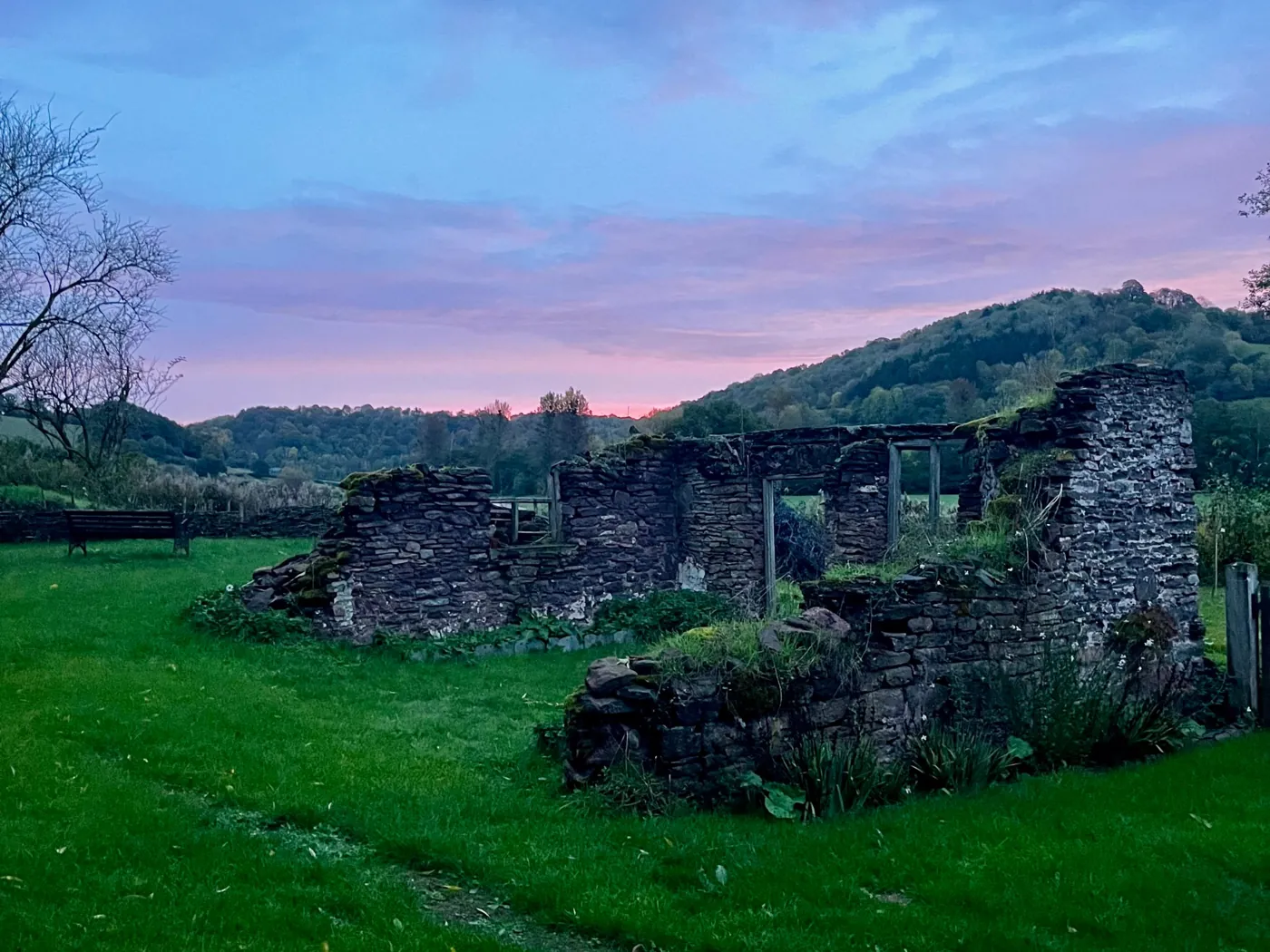
Ruthlin itself grew from Ruthlin Farm, just upstream of the mill. Around 1800 it was farmed by the Farr family, among sheep, cattle and cider orchards. We do, from time to time, get sheep escaping into our meadows. Always a happy sight, although not for the poor farmers. Later census returns call it Rullings Farm and Ruthlins Farm. The old farm buildings have since been converted, and they are now our home and your retreat. The river has shifted its course over the centuries while the border has stayed put, so parts of Ruthlin are in England and parts are in Wales.
Across the river in Herefordshire is Llanrothal, where the Vaughans had lived at Llanrothal Court since at least the 1500s. A footbridge once linked the court and St John’s church to the Welsh bank here. It is marked on the Ordnance Survey map of 1885 and gone by 1904.
Skenfrith Castle and village
A 1926 account of the border described Skenfrith as nestling “where three sweet valleys meet”, and it is still a very good description. The village is small enough to explore in an hour, and full of things that reward a closer look.
Skenfrith Castle
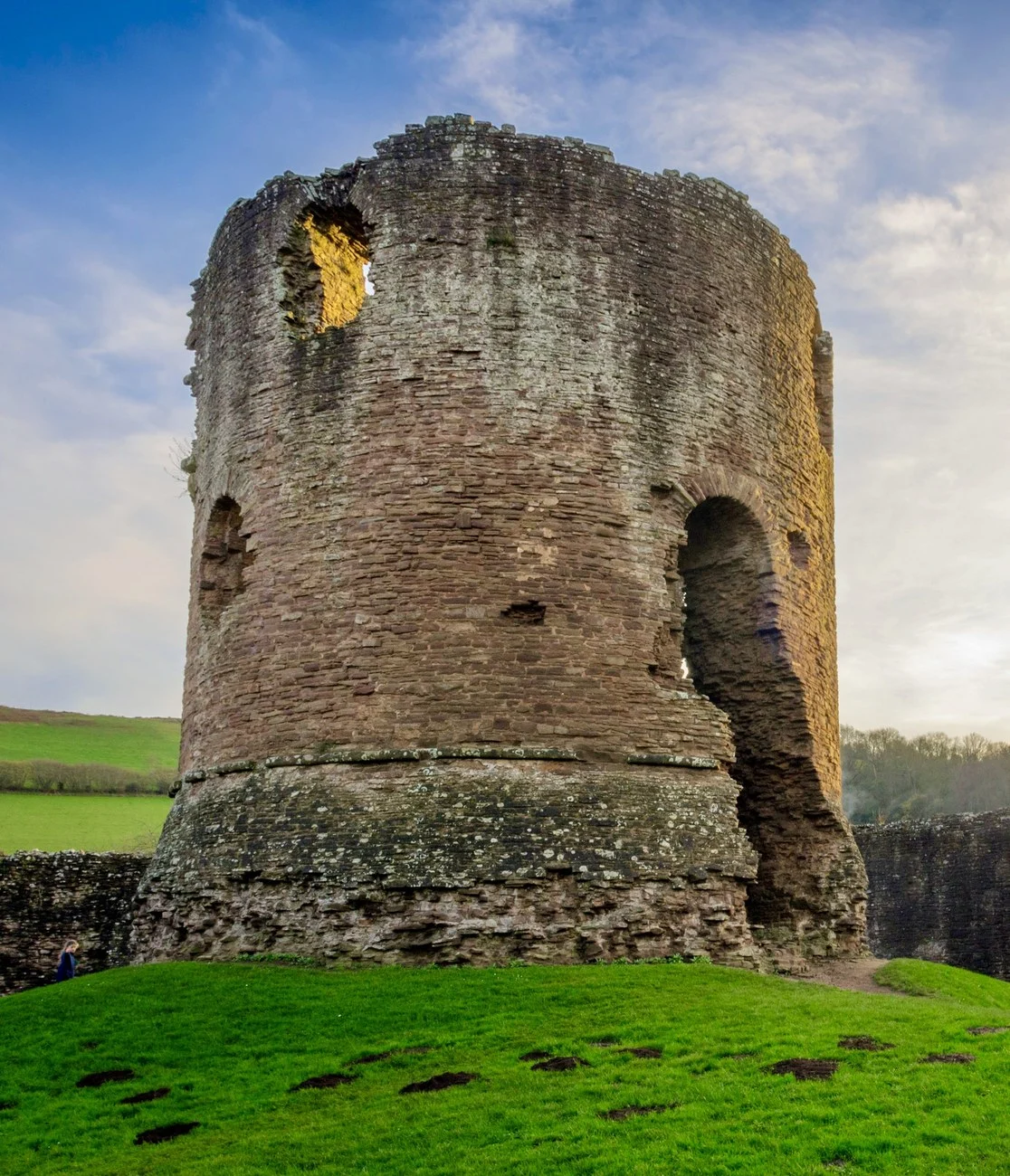
Skenfrith Castle is one of the Three Castles of Gwent, with Grosmont and White Castle. The first castle here followed the Norman conquest. The ruins you see today were built between about 1219 and 1232 by Hubert de Burgh, with a round keep on a low mound inside the curtain wall and the river running along one side. The site tells you why it is here: it guards a crossing on an old route between England and Wales. The castle is owned by the National Trust and looked after by Cadw. It is free to enter and open in reasonable daylight hours all year. Go early or late and you will often have it to yourselves. In summer it can be a little swamped by tourists and camper vans.
St Bridget’s Church
Next to the castle, St Bridget’s has a low, massively sturdy tower, with walls about one and a half metres thick, topped by a timber “dovecote” belfry. Towers like this are typical of the Welsh border, where churches were built with defence as well as worship in mind. Inside, look for the chest tomb of John Morgan, who died in 1557. He was the last governor of the Three Castles and represented Monmouthshire in Parliament, and the incised figures of him and his wife are surrounded by an inscription. The church also keeps the Skenfrith Cope, a richly embroidered 15th-century vestment that was found in use as an altar cloth in the 19th century and is now displayed behind glass. Churches are usually open in daylight. Services are at 9.15 most Sundays and are quite special.
The bridge and the mill
The stone bridge over the Monnow was rebuilt in 1824. There has been a mill in Skenfrith village since at least the 13th century: it was valued at £9 in a survey of 1249. The present mill building is privately owned, but unlived in.
For more on the castle, church and bridge, illustrated with pen and ink drawings made in 1899, see our Skenfrith history page.
Castles, churches and legends of the border
Grosmont Castle
Grosmont was once a small borough, which explains its castle, its large church and its town-sized street. The castle was remodelled in the 13th and 14th centuries as a comfortable residence. Henry of Grosmont, the first Duke of Lancaster, was born here around 1310, and the castle was attacked during Owain Glyndŵr’s rising in 1405. St Nicholas’s church, with its octagonal spire, is big enough for a town. You can explore both before having lunch at the Angel.
White Castle
The most complete-looking of the Three Castles stands alone in open farmland, with a water-filled moat and tall gatehouse towers. It is quiet, atmospheric and a short drive away.
Garway church and the Knights Templar
Just over the border in Herefordshire, St Michael’s church at Garway was built by the Knights Templar in the late 12th century. The foundations of their round nave, modelled on the Church of the Holy Sepulchre in Jerusalem, are marked out beside the church. Nearby is a remarkable circular dovecote with hundreds of nesting holes, built in 1326 for the Knights Hospitaller, who took over after the Templars were suppressed. The dovecote stands on private farmland, and visits are by arrangement. Garway Hill above the village rises to 366 metres and has wide views across the border.
Kentchurch, Jack o’ Kent and Owain Glyndŵr
Kentchurch Court, a few miles upstream, has been the home of the Scudamore family for centuries. Tradition says that Owain Glyndŵr spent his last years here with his daughter Alys, who married a Scudamore. It is a private house, so enjoy it from the lane. The border is also Jack o’ Kent country. Jack was a local wizard who, the stories say, outwitted the Devil time and again. In one tale he tricked the Devil into building a bridge over the Monnow in a single night. The Devil had claimed the first soul to cross, so Jack threw a bone over and a dog ran after it.
Kilpeck
Kilpeck’s little Norman church is famous for its 12th-century carvings: dragons, beasts, musicians and some rather earthy figures around the south doorway and under the eaves. It is about 25 minutes away and well worth it.
The Skirrid
The Skirrid, near Abergavenny, has long been called the Holy Mountain. Its great cleft is said to have split at the Crucifixion, and the 1926 account repeats an older local tradition that the ark came to rest there. It makes a fine short climb on a clear day.
The River Monnow: wildlife, swimming and fishing
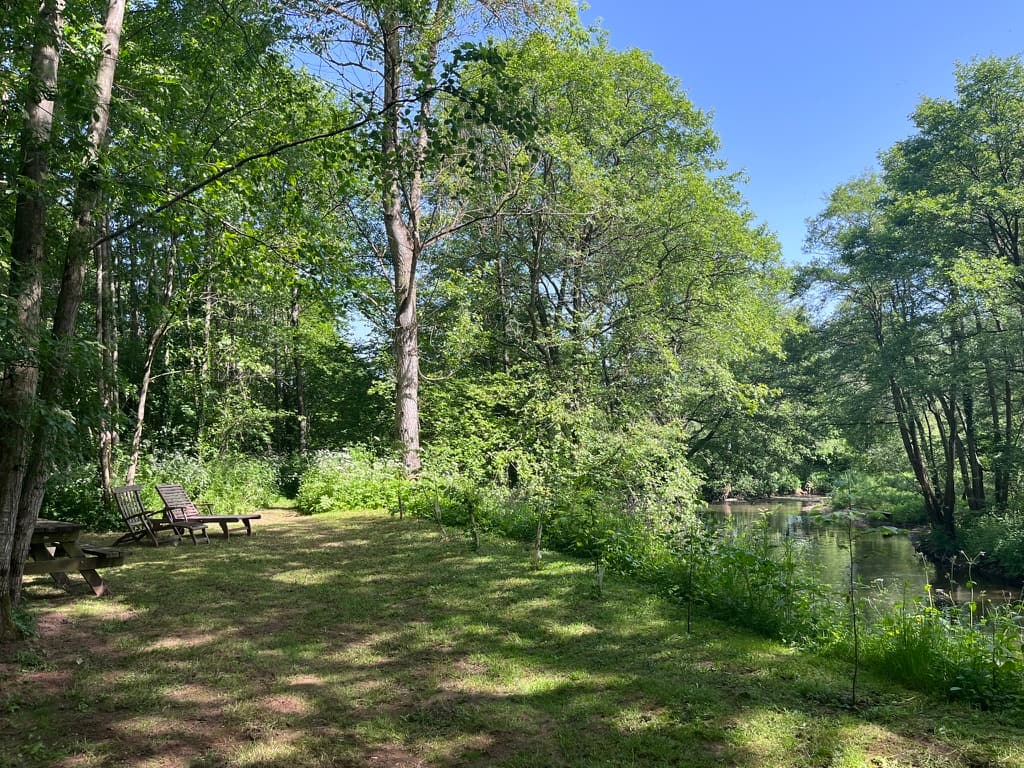
The river is the heart of Ruthlin. The Monnow is a clean, fast-flowing border river, and almost perfect in its wildlife. Kingfishers, dippers and grey wagtails work the riffles. Brown trout and grayling rise to the mayfly hatch in late May and early June. Otters live on the river, though they are shy and you would be lucky to see them; their tracks and spraints on a sandy margin are easier to find than the animals themselves. In autumn, salmon run upstream to spawn, allegedly. We have never seen (or caught) one.
Swimming
The river is a well-loved summer swimming spot, and Ruthlin has its own little beach on the Monnow. In late spring it is like swimming in champagne. Heaven. Our daughters swam too close to a kingfisher nest and were circled by the birds while they played. The river is a living thing rather than a swimming pool: it rises quickly after rain in the hills, and the current can be stronger than it looks. We are always happy to show you where it is safe to get in and out.
Before you go in, check the latest readings and the official flood warnings on our Skenfrith river levels page.
Fishing
Sadly, Ruthlin lost its own fishing rights in the 1950s, but with a little notice we can arrange fishing on the Skenfrith village beat. It runs for about 1,100 yards upstream from the bridge opposite the Bell, and it is mostly double-bank fishing. Few beats have a finer backdrop: the castle stands right beside the water. You will need a rod licence, and the Wye and Usk Foundation’s Fishing Passport sells day tickets for other beats on the Monnow.
Walks near Skenfrith
From the door
Riverside and field walks start from Ruthlin itself. Ask us for our favourites. The area is covered by the Ordnance Survey Explorer maps OL13, OL14 and 189.
Skenfrith to Box Farm circular
About 6 miles (3 to 3½ hours). It follows the Three Castles Walk towards Grosmont, then returns through woods, farmland and the Black Brook valley. It is one of the best-kept local routes and a lovely half day.
The Three Castles Walk
About 19 miles. This waymarked circuit links Skenfrith, Grosmont and White Castle. It breaks naturally into three stages: Skenfrith to White Castle (about 7 miles), White Castle to Grosmont over Graig Syfyrddin (about 6½ miles) and Grosmont back to Skenfrith (about 5½ miles). Most guests walk one stage rather than the whole thing.
Garway Hill
A short climb to big skies and views over the Black Mountains, the Malverns and the Forest of Dean. Pair it with Garway church.
The Monnow Valley Walk
It runs about 40 miles from Monmouth to Hay-on-Wye along the river. Visit Monmouthshire no longer maintains the whole route, so treat it as a walk to plan in sections, with a map.
Fields here can be muddy and have stiles and livestock, so good boots are worth packing, especially in winter.
Pubs and restaurants near Skenfrith
Rural pubs change their hours often, and many kitchens close on Mondays and Tuesdays. For a midweek stay, we suggest booking dinners before you arrive, or planning a night or two of cooking in. Please check opening times before you set off.
- The Bell at Skenfrith. Our village inn was badly damaged in the November 2025 floods and has been closed since. Check its website for news of reopening.
- The Angel Inn, Grosmont. A proper village pub, about 15 minutes away, and ideal after a castle walk.
- The Garway Moon Inn. A country pub on the common at Garway, about 10 minutes away. Our favourite.
- 1861, Cross Ash. A restaurant with rooms serving ambitious cooking in a Victorian pub building, about 15 minutes away. Book ahead.
- The Walnut Tree, Llanddewi Skirrid. One of the most celebrated restaurants in Wales, near Abergavenny, about 25 minutes away. Book well ahead.
Cider, wine and provisions
- Apple County Cider, near Skenfrith. A cider farm with a shop and tastings, minutes away.
- White Castle Vineyard, Llanvetherine. Award-winning Welsh wine. Tours and tastings are usually by booking.
- Parva Farm Vineyard, Tintern. Wine and mead above the Wye, a natural partner for the abbey.
- Raglan Farm Shop and Pengethley Farm Shop (near Ross-on-Wye). Good places to stock up.
- Monmouth: markets on Fridays and Saturdays, and the Marches Deli on Monnow Street.
- Abergavenny: markets on Tuesdays, Fridays and Saturdays, plus a farmers’ market on the fourth Thursday of the month.
Days out from Skenfrith
Drive times are approximate, from Ruthlin, and the lanes are narrow, so allow a little extra.
| Where | Roughly | Why go |
|---|---|---|
| Monmouth | 15–20 min | The fortified Monnow Bridge, independent shops, Henry V’s birthplace and the Kymin’s Naval Temple above the town |
| Raglan Castle | 20–25 min | A grand late-medieval castle, more palace than fortress |
| Ross-on-Wye | 25 min | A market town above the Wye, in cider country |
| Kilpeck | 25 min | Extraordinary Norman carving |
| Abergavenny | 25–30 min | Markets, food shops and the Sugar Loaf and Skirrid |
| Hereford | 30–35 min | The cathedral, the Mappa Mundi and the chained library |
| Symonds Yat Rock | 30–40 min | A famous view over a loop of the Wye, and peregrines in spring |
| Tintern Abbey | 35–45 min | Great Cistercian ruins in the Wye Valley |
| Chepstow Castle | 45–55 min | Begun in 1067 and usually called the oldest stone castle in Britain, on a cliff above the Wye |
| Llanthony Priory | 40–50 min | Ruins in a hidden valley of the Black Mountains |
| Hay-on-Wye | 50–60 min | The town of books |
A few notes for 2026–27. Monmouth’s Shire Hall is closed for refurbishment until 2027. At the Kymin, the Round House is now a holiday let, but the grounds and the Naval Temple of 1800 are open. Parts of Tintern’s abbey church are closed for a long-running conservation project. Please check Cadw and the National Trust before you go.
A day in the Wye Valley
Ruthlin is in the Monnow valley rather than the Wye Valley itself, but the Monnow joins the Wye at Monmouth, a quarter of an hour away, so the Wye Valley makes an easy day out. Downstream from Monmouth the road follows the river south through Redbrook, past Tintern Abbey and on to Chepstow. Upstream are Symonds Yat Rock and Ross-on-Wye. A good day: the Kymin above Monmouth in the morning, Tintern in the afternoon, and Chepstow Castle if there is light left. Or go north to Symonds Yat for the view, and the peregrines in spring. If you would rather go on foot, the Wye Valley Walk follows the river all the way.
Skenfrith through the seasons
Spring. Birdsong, lambs and primroses along the lanes. Walk the Box Farm circular, watch the river come alive, and visit Garway before the leaves close in.
Summer. The mayfly hatch, long evenings, swimming when the river is low and clear, and suppers outside. It is the time for the longer Three Castles stages, and for Hay.
Autumn. Cider apples, hedgerow fruit and the salmon run. Buy cider at the farm gate, walk through the colour, and see the castles in low light.
Winter. This is the season we think suits Ruthlin best. A short walk to Skenfrith Castle on a frosty morning, a look round St Bridget’s, an afternoon in Monmouth or Hereford if it rains, and then back to the fire. The bare trees make it easier to spot dippers and kingfishers. Daylight is short, so plan walks for the middle of the day and shop for supplies on the way in.
Events to plan a stay around in 2027
- 27 May – 6 June: Hay Festival, its 40th year.
- 28–30 May: Gŵyl Devauden, music and food near Monmouth.
- 29 May – 20 June: Gaia at Hereford Cathedral, Luke Jerram’s giant illuminated Earth. Free during normal opening hours.
- August: the Monmouthshire Show (date to be confirmed).
- September: Abergavenny Food Festival (2027 dates to be announced).
- The second Saturday of every month: Tintern local produce market.
Popular weekends book up early, so if you have your eye on one, check availability.
Stay at Ruthlin
Ruthlin is a private retreat for two, with nine acres beside the Monnow, a freestanding bath and no television. See what a stay is like or look around our self-catering accommodation in Skenfrith.
Sources and thanks
The history of Ruthlin Mill is drawn, with thanks, from Philip Vaughan’s research article A Mill on the Monnow: Ruthlin – Cornmill to Papermill. Phil volunteers with The Mills Archive. Some older Skenfrith lore comes from Bygone Days in the March Wall of Wales (1926). Opening times and event dates were checked in October 2026, but please check before travelling.